
Air Fryer Airflow Development: Let the Full Load Set the Brief
A full basket can expose a weak design without identifying its cause. Learn how EVO's joint fan, air-path and structural review turns that result into better prototype comparisons and sourcing decisions.

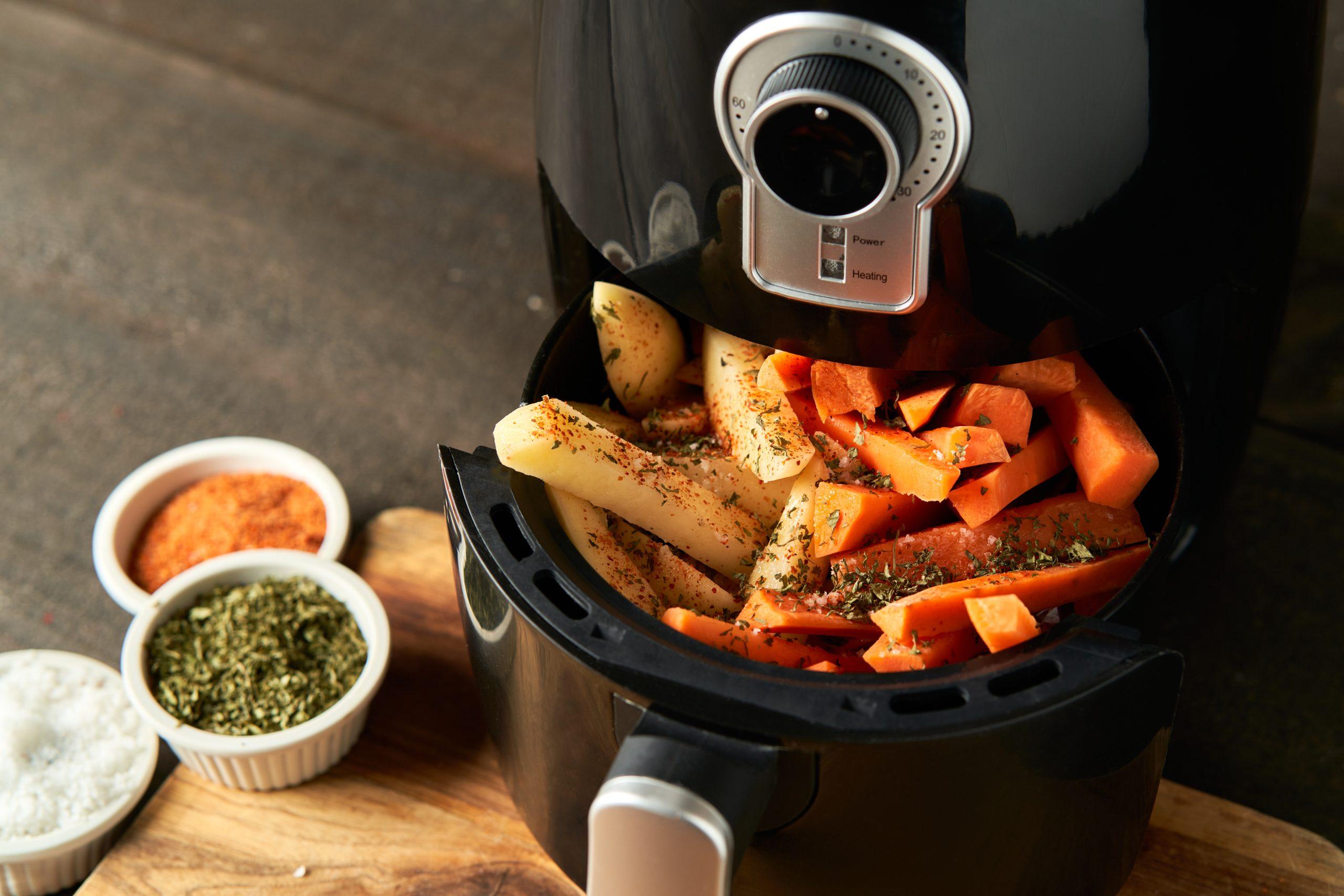
Before accepting a photograph of golden fries as evidence of good airflow, ask to see the center of the basket.
Consider an illustrative sample review. With 500 g of fries, the proposed air fryer produces an even-looking batch. With 1 kg, the exposed pieces color early while those buried in the center remain pale. Increasing fan speed is an obvious candidate. It could also make the outer pieces drier and the appliance louder while leaving the original problem unresolved.
The development decision is which explanation to investigate first. The larger load has changed the space available for air, the surfaces exposed to heat and the amount of food and water the appliance must handle. Choosing a fan upgrade before separating those effects risks paying for an improvement in the wrong place.
At EVO, airflow development brings fan speed, air paths and product structure into the same review, with prototype comparisons informing the balance between performance, noise and usability. That approach becomes useful to a sourcing team when the brief names the meal that must improve, the conditions under which it must improve, and the compromises the brand will accept.
The full basket changes more than the airflow
The 500 g demonstration answers a limited question: can this configuration produce an acceptable result under that load and routine? It does not explain why the 1 kg batch falls behind.
If the food specification is unchanged, the full batch adds thermal mass and water as well as changing its arrangement. Pieces can shield one another from air and direct radiant exposure. The control system may respond differently after loading. More than one explanation can therefore fit the same photograph.
Record where the difference appears. Are all sampled positions slower to reach the agreed endpoint, or is there a persistent gap between the center and the exposed edges? Does a halfway shake redistribute the pale pieces and substantially change the result? These observations guide the next comparison; none identifies a cause by itself.
A halfway shake also has a commercial meaning. If the product brief allows it, test that routine consistently. If the promise is a family portion with minimal intervention, a carefully timed shake should not quietly become the condition that makes the approval sample pass. The intervention belongs in the agreed product promise.
The same applies to portion size. A smaller batch can be a legitimate operating recommendation. It is a different answer from demonstrating that the intended full load works.
A stronger stream can still miss the food that needs it
There are two questions behind the word “airflow”: how much air the installed system moves, and how that air reaches the food. A larger total circulation rate does not establish that the buried pieces receive the exposure they need.
AMCA's explanation of fan curves places the operating point at the intersection of the fan curve and the system-resistance curve. RPM is one input to that relationship. It is not a complete specification of the installed result. A fan selected under one test arrangement cannot simply be assumed to deliver the same behavior after the surrounding passages and restrictions change.
For the loaded basket, a possible concern is bypass: circulation may favor an open route around a dense pile instead of reaching its sheltered surfaces. A stronger fan could increase movement along that easier route. Whether it improves the central pieces depends on the actual configuration. Without a measured flow field or a discriminating comparison, it remains a hypothesis.
This is where structural details become development variables rather than styling details. Basket openings, crisper-plate clearance, the space around the load and the return route can change the paths available. The objective is not to maximize the number of holes. It is to make the intended loading arrangement work without introducing an unacceptable restriction or uneven exposure elsewhere.
An accessory can change that arrangement after the main appliance has already been evaluated. Philips' guidance on paper and foil warns that covering the basket bottom reduces airflow and cooking performance in the products covered by that guidance. That is not a universal rule for every liner. It is a concrete reason to include the intended accessories and their positions in the approval configuration.
Heat delivery is the second part of the problem. MIT's convection notes relate convective heat transfer to the temperature difference and a coefficient affected by near-surface flow. Two pieces exposed to the same nominal air temperature can receive different convective heating if their local flow conditions differ. Direct radiation and heat conduction within the food add other routes; a convection relationship alone cannot predict the cooking result.
A wet surface introduces another demand on that heat. Lienhard and Lienhard's *A Heat Transfer Textbook* explains the coupling between evaporation and heat input. Energy used to evaporate water is not simultaneously available to raise the surface temperature. In a food load, this gives another reason to question an airflow-only diagnosis: local exposure, moisture removal and internal heating can evolve differently across the batch. The textbook's idealized evaporation examples are not a temperature or cooking-time model for fries.
A color improvement at the edge, a faster chamber-temperature recovery and a more even full batch are three different results. The sourcing brief should say which one earns approval.
Give the next prototype comparison a prediction
Start with a repeatable baseline. Keep the food specification and starting condition, batch mass, approved basket and accessory arrangement, program, preheating and handling routine consistent across repeat runs. Preserve observations by position rather than mixing the entire batch into one final photograph. Color, texture and any relevant internal endpoint should be interpreted together; appearance alone is not the whole claim.
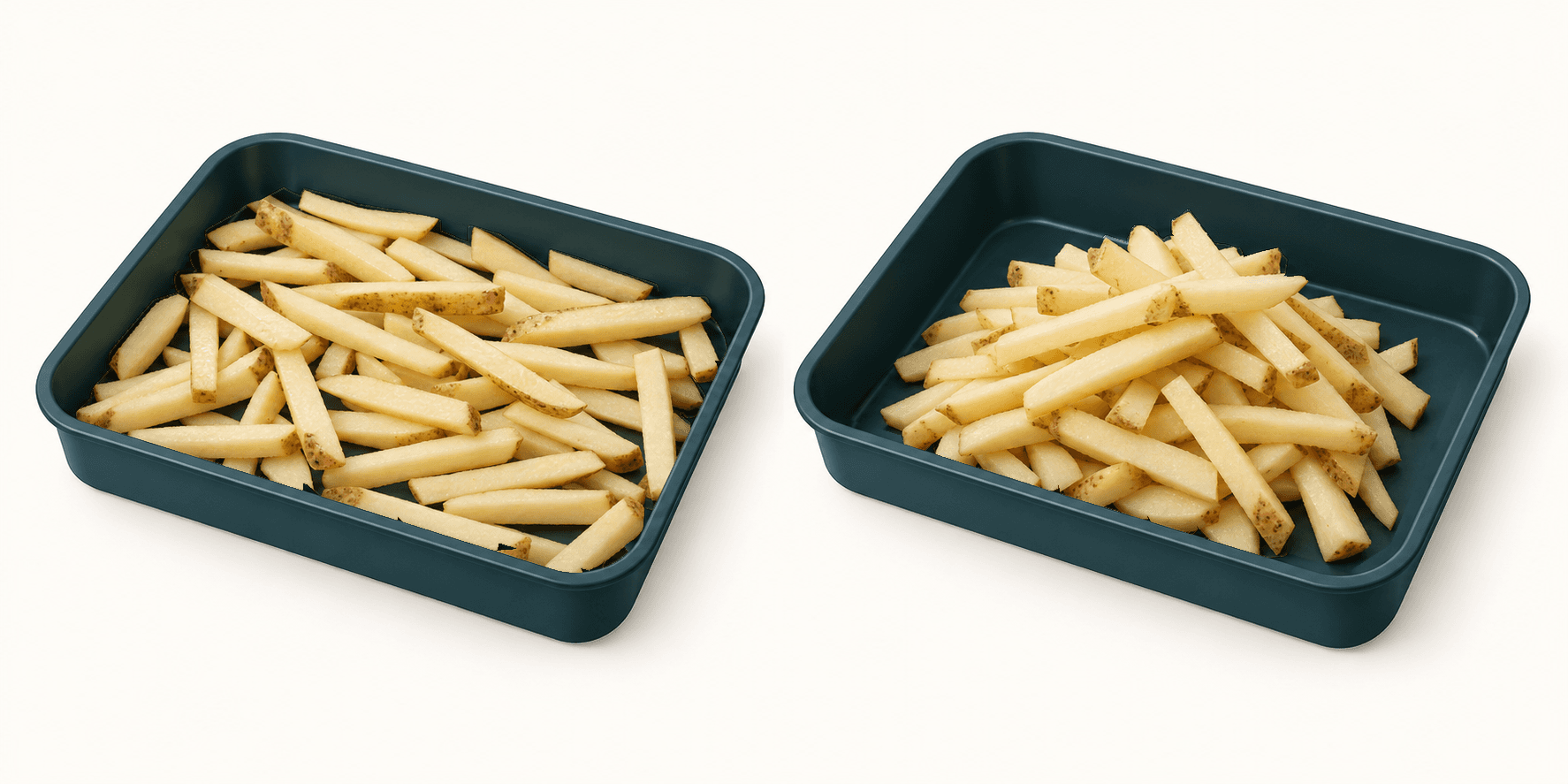
Then choose a comparison with a prediction attached to it.
If the central pile appears to be the weak area, compare the same batch mass distributed more evenly with a deliberately deeper central arrangement, within the approved basket. An improvement would make loading and exposure worth pursuing. It would not isolate airflow: rearrangement also changes shielding and radiant exposure. The conclusion is narrower than “the fan is too weak.”
If the whole batch seems delayed, inspect the recovery after loading and the actual heater behavior alongside food results. A temperature setting is not a record of delivered heat. Where feedback changes heater operation, the same displayed setting can accompany different heater-on periods. Changing fan speed can also change the temperature seen by the controller. A speed comparison should therefore observe the coupled thermal response rather than assume it stayed fixed.
Take care with the measurement itself. The heat-transfer textbook shows how an exposed thermocouple can exchange radiation with chamber surfaces while exchanging heat with the air. Record probe location and arrangement before treating its reading as the air temperature. Even a well-measured local air temperature does not describe every food surface.
The table below sets out useful next questions for the illustrative full-load problem. Each comparison can narrow an explanation; it does not replace product-specific engineering judgment.
| Validation question | Evidence to request | What would weaken the working explanation |
|---|---|---|
| Is the central loading arrangement limiting exposure? | Same food and batch mass, repeat runs with controlled spread versus central depth; compare center and edge endpoints | Rearrangement produces no repeatable change in the pattern; investigate other exposure, heat or program factors |
| Is recovery after loading contributing to the delay? | Food results alongside defined-location temperature traces and observed heater-on behavior, using the same starting condition | The proposed recovery difference does not recur, while the food difference does; a recovery-only explanation becomes weaker |
| Does increased fan speed solve the original food target? | Approved speed settings with the same assembly and routine; observe thermal response, center/edge results and sound | Only exposed pieces improve, or the full-load result requires an unacceptable noise or drying tradeoff |
| Does a proposed path or basket revision add repeatable value? | Matched baseline and revision runs with recorded geometry, program and handling; repeat the comparison | Improvement disappears in repeats or depends on an unrecorded change in food preparation or intervention |
A supplier can produce a better-looking plate by changing the fan, basket and program together. That may be a useful candidate configuration. It is weak evidence for crediting any one component, and it leaves procurement unsure which changes must be retained. Use the improved candidate to test the product promise; use more controlled comparisons to explain the improvement when that explanation affects the next decision.
Do not mistake a single favorable run for a robust choice. If the result changes substantially between repeats, find out whether food preparation, load arrangement, control behavior or assembly variation is moving with it. More prototypes will not resolve a comparison whose conditions are drifting.
For a baking accessory, the target changes again. A tin can alter exposed surfaces and available circulation space, while the desired internal endpoint differs from a fry-crisping target. Approve the actual accessory position and program. Keeping the highest fan setting merely because it looked effective for fries is not a development rationale.
A quieter mode has to earn its place on the same plate
A lower fan setting that sounds comfortable during an empty warm-up has not yet demonstrated a quieter family-meal mode. Test the acoustic behavior in the operating state that achieves the agreed food result. If the quiet candidate needs a lower portion or a different handling routine, make that difference visible in the comparison.
RPM is not the only acoustic lever. ebm-papst's discussion of fan sound sources identifies inflow disturbances and tip-gap flow as contributors in its fan-engineering context. The relevant air-fryer question is whether the installed air path or assembly contributes to a sound that needs investigation. The source does not promise a particular reduction for an air fryer.
Compare the mode, measurement position and background conditions, and listen as well as recording the overall level. A persistent tone or intermittent rattle can deserve attention that a single number does not capture. None of this justifies promising a fixed decibel improvement before measurement.
Approve the assembly that produced the result
Once a configuration works, purchasing needs to know what made that sample different.
Record the fan and drive revision, relevant clearances and passages, heater/guard arrangement, basket and crisper plate, approved accessories and operating program. Keep the tested load and handling conditions beside them. A finished-batch photograph cannot reconstruct that configuration.
Substitutions are possible, but similar RPM or external dimensions do not establish equivalent cooking performance. A replacement fan or revised basket can change the installed result. Identify which accepted endpoint each change could affect and repeat the relevant comparison before treating it as interchangeable.
Bring EVO the load that exposes the limitation, the accepted routine and your noise, structure and accessory constraints. That gives its joint review a development brief, rather than just a motor request.
Sources
- EVO, Airflow Developed Around Your Product Goals — EVO Airflow Engineering capability statement.
- AMCA, Straightening Out Fan Curves.
- MIT, Convective Heat Transfer.
- Philips, Can I use baking paper/tin foil in my Philips Airfryer?.
- ebm-papst, Tracking down sound sources.
- John H. Lienhard V and John H. Lienhard IV, A Heat Transfer Textbook, 6th edition, sections on thermocouple radiation exchange and simultaneous heat and mass transfer.

Allen
Product Development & R&D, EVO
Focused on air fryer product development, engineering evaluation, OEM/ODM, sourcing and market analysis.
Related Insights
Should Optional Air Fryer Features Be Quoted Separately?
Yes. Ask suppliers to price the base model and each option separately, including tooling, testing and packaging where relevant.
Read ArticleWhat Should I Confirm Before Approving an Air Fryer Sample?
Check the sample revision, accessories, controls and agreed test results against the RFQ, and record any approved deviations.
Read ArticleHow Should I Compare Air Fryer Supplier Quotes?
Compare the same configuration, quantity and included scope; clarify assumptions and exclusions before comparing unit prices.
Read ArticleHave a question about this topic?
Ask EVO about the product technology, development considerations or sourcing implications discussed in this article.