
Why an Air Fryer Quotation Is Not Yet a Sourcing Specification
A supplier quotation can start an air fryer project, but its voltage, capacity, packaging, MOQ and price fields must be converted into controlled configurations and approval evidence.

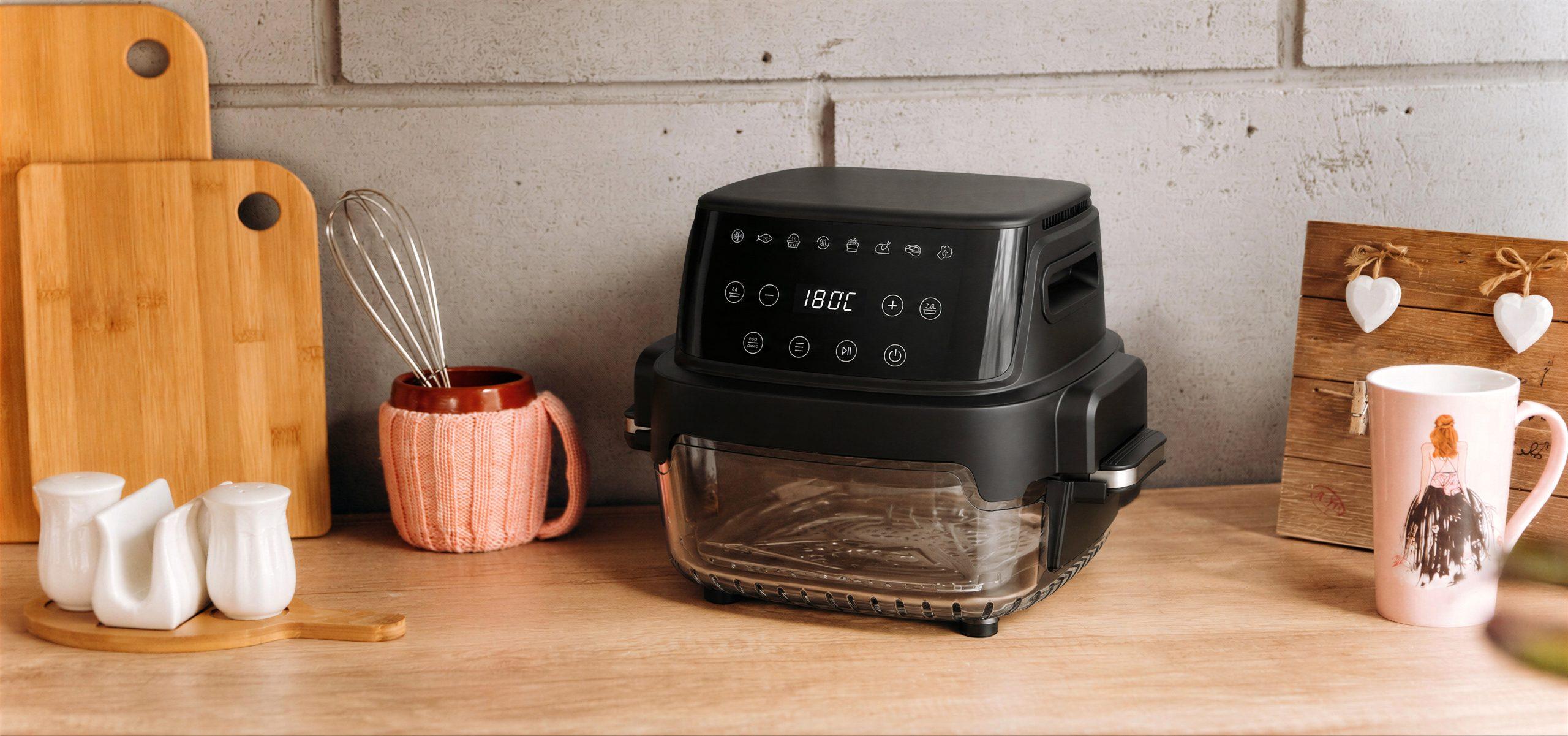
An air fryer quotation can be commercially useful long before it is technically complete. A real quotation may already identify the model, voltage and wattage options, vessel capacities, control format, product dimensions, gift-box dimensions, carton quantity, shipment loading and minimum order quantity. That is enough to begin a price and logistics conversation. It is not enough to approve the product that will eventually be manufactured.
The gap matters because each field carries assumptions. A capacity figure can describe nominal vessel volume rather than usable cooking area. Two voltage options can imply different heaters, cords, control settings or safety evidence. A carton loading figure can be mathematically correct while glass components remain insufficiently protected for the intended distribution route.
Sourcing teams should treat the quotation as the first commercial map of a product—not as the finished specification. The next step is to convert each quoted promise into an identified configuration, an evidence request and an acceptance decision.
The quotation behind this guide makes that transition concrete. One model line combines 110–120 V at 1,300 W and 220–240 V at 1,500 W, a 1.5 L and 4.0 L glass-vessel set with storage lids, electronic control, product and packaging dimensions, two units per master carton, container-loading quantity and a 1,000-unit MOQ. None of those fields is incidental: together they expose five connected approval tasks—regional electrical identity, vessel-to-control validation, food-contact traceability, glass-pack protection and reconciliation of commercial assumptions. That relationship, rather than the confidential unit price, is the useful sourcing evidence.
Read the quotation as a network of dependencies
A quotation is arranged in columns, but the product is not. Model identity connects to electrical rating; electrical rating connects to heater and control behaviour; vessel geometry connects to cooking performance, cleanability and packaging; packaging dimensions connect to freight economics and damage risk. Changing one item can invalidate several apparently settled fields.

Create one configuration register for every offered variant. It should tie the supplier’s model number to destination market, rated voltage and frequency, wattage, plug and cord, controller revision, heater and protection architecture, vessel set, supplied lids or accessories, colour, packaging version and applicable reports. If two market versions differ, the register should show where.
Electrical options need separate product identities
A quotation listing one wattage for 110–120 V and another for 220–240 V has identified at least two electrical constructions. They may differ in current, heater design, cord set, control calibration and report coverage.
IEC 60335-2-9 addresses portable household cooking appliances, and its 2026 pre-release revision explicitly adds requirements for portable air fryers. The certification route depends on the destination market, but the sourcing implication is clear: the safety file must match the version being purchased. “Same model, different plug” should never be assumed because the enclosure looks identical.
Ask the supplier for a market-version matrix before sample approval. Record the rating, plug and cord, protection components, labels, instructions, critical-component list, report identity and deviations from the base platform. Performance tests should state their voltage and frequency too.
Capacity should become an interface specification
Quoting glass vessels with different nominal capacities communicates flexibility, but it does not define the cooking interface. The buyer still needs internal dimensions, usable food area, load guidance, heater clearance, base geometry, support compatibility, lid fit and the control behaviour expected with each vessel.
The smaller and larger vessel can change food depth, airflow resistance, thermal mass, heat-up behaviour and exposure to hot surfaces. The specification should state whether programs and temperature control are common to both or validated separately.
Give every vessel and lid a controlled identifier. Link it to material, cleaning instructions, food-contact evidence, packing location and replacement-part policy. Capacity then becomes traceable to real hardware rather than remaining marketing shorthand.
That identifier also prevents a substitution from arriving as an apparently harmless accessory change. If the vessel geometry, glass composition, lid material or support interface changes, the buyer can identify which fit, thermal, food-contact and packaging checks must be reopened.
Food-contact evidence must follow the actual parts
The European Commission states that food-contact materials placed on the EU market must comply with Regulation (EC) No 1935/2004 and be manufactured under the good-manufacturing-practice framework of Regulation (EC) No 2023/2006. Material-specific measures can add migration limits, test conditions, declarations and supporting-document requirements.
For a product using glass vessels, lids, supports and other food-adjacent components, a generic “food grade” statement is not an evidence map. List the intended food-contact parts and foreseeable contact conditions. For each, request material identity, applicable declaration or report, temperature and food-use limitations, and the production change that would trigger review.
The quotation need not expose confidential formulations, but the buyer must establish that evidence supports the actual colour, material, construction and use conditions. A report for a similar component is a lead for review, not automatic approval.
Packaging data should lead to a protection plan
Product, gift-box and master-carton dimensions, net weight, gross weight, pieces per carton and container loading support early landed-cost and warehouse planning. They do not show whether the packed product will survive distribution.
Glass vessels make this distinction visible. The packaging specification should show how every vessel and lid is restrained, where loads are transferred, whether components can contact one another, and what happens during drop, vibration, compression and repeated handling. The selected test sequence should reflect the actual route and pack configuration.
Reconcile the numbers before freezing them. Product net weight, accessories, internal packaging and carton tare should reasonably bridge to gross weight. Gift-box dimensions and carton arrangement should reproduce the master-carton dimensions within realistic allowances. Container quantity should state whether pallets are included. A mismatch is not proof of failure; it is a prompt to clarify the commercial model.
Do this reconciliation before committing artwork or purchase quantities. Packaging corrections made after graphic files and container plans are approved tend to appear as avoidable schedule changes rather than as the product-definition work they actually are.
MOQ and price belong to an assumptions register
MOQ and unit price are outputs of a defined offer. Colour count, printing method, plug type, packaging, accessories, certification responsibility, inspection level and payment terms can all change them.
Require assumptions and exclusions beside the price rather than in later email threads. Separate tooling, certification, testing, artwork and samples from recurring unit cost. Identify quotation validity, Incoterm, loading basis, warranty assumption and spare-part scope.
One supplier may offer a lower starting price but exclude market evidence or packaging development. Another may include a mature platform and documented configuration. Compare the same scope and make uncertainty visible.
The assumptions register should travel with every revised quotation. When MOQ, accessories or market scope changes, the team can see whether the new price reflects purchasing leverage, a narrower deliverable or a different product configuration.
Convert every quoted field into an approval object
The quotation becomes a sourcing specification when each material field has an owner, evidence route and acceptance state.
| Quoted field | What it establishes | What remains undefined | Approval evidence |
|---|---|---|---|
| Model and configuration | Commercial reference | Controlled variant and frozen assemblies | Configuration register, BOM and approved sample |
| Voltage and wattage | Offered electrical options | Frequency, cord, protection and market evidence | Rating file, critical-component list and reports |
| Vessel capacities | Nominal proposition | Usable geometry, interface and program behaviour | Drawings, fit checks and validation by vessel |
| Product and pack dimensions | Logistics envelope | Tolerances, pack arrangement and protection | Controlled drawings and distribution validation |
| Net/gross weight and loading | Freight inputs | Reconciliation and pallet assumptions | Approved pack-out and loading calculation |
| MOQ and price | Commercial offer | Included scope, exclusions and validity | Signed assumptions register and final quotation |
Approval can progress through quoted, under review, conditionally accepted and frozen states. The supplier can then see which change requires a revised quotation, new sample, document review or revalidation.
Keep the quotation connected to production
After nomination, carry verified fields into the product specification, validation plan, golden-sample record, packaging specification and purchase documentation. Record which early assumptions changed and why.
The chain should be readable in both directions. A production change can be traced back to affected commercial and validation decisions; a quoted claim can be traced forward to the approved component, method or report supporting it.
A quotation begins the conversation by describing what a supplier is prepared to offer. A sourcing specification finishes the decision by defining what both parties have agreed to build, verify and preserve.
Sources
- International Electrotechnical Commission, “IEC 60335-2-9:2026 — Particular requirements for grills, toasters and similar portable cooking appliances (pre-release version)”: https://webstore.iec.ch/en/publication/116678
- European Commission, “Food Contact Materials”: https://food.ec.europa.eu/food-safety/chemical-safety/food-contact-materials_en
- European Commission, “Food Contact Materials Legislation”: https://food.ec.europa.eu/food-safety/chemical-safety/food-contact-materials/legislation_en
- EVO, air fryer quotation record (22 September 2026).

Allen
Product Development & R&D, EVO
Focused on air fryer product development, engineering evaluation, OEM/ODM, sourcing and market analysis.
Related Insights
Should Optional Air Fryer Features Be Quoted Separately?
Yes. Ask suppliers to price the base model and each option separately, including tooling, testing and packaging where relevant.
Read ArticleWhat Should I Confirm Before Approving an Air Fryer Sample?
Check the sample revision, accessories, controls and agreed test results against the RFQ, and record any approved deviations.
Read ArticleHow Should I Compare Air Fryer Supplier Quotes?
Compare the same configuration, quantity and included scope; clarify assumptions and exclusions before comparing unit prices.
Read ArticleHave a question about this topic?
Ask EVO about the product technology, development considerations or sourcing implications discussed in this article.