
Air Fryer Countertop Clearance Is a Product Specification, Not a Manual Footnote
Published clearance instructions show that an air fryer’s usable footprint is larger—and more architecture-dependent—than its housing dimensions.

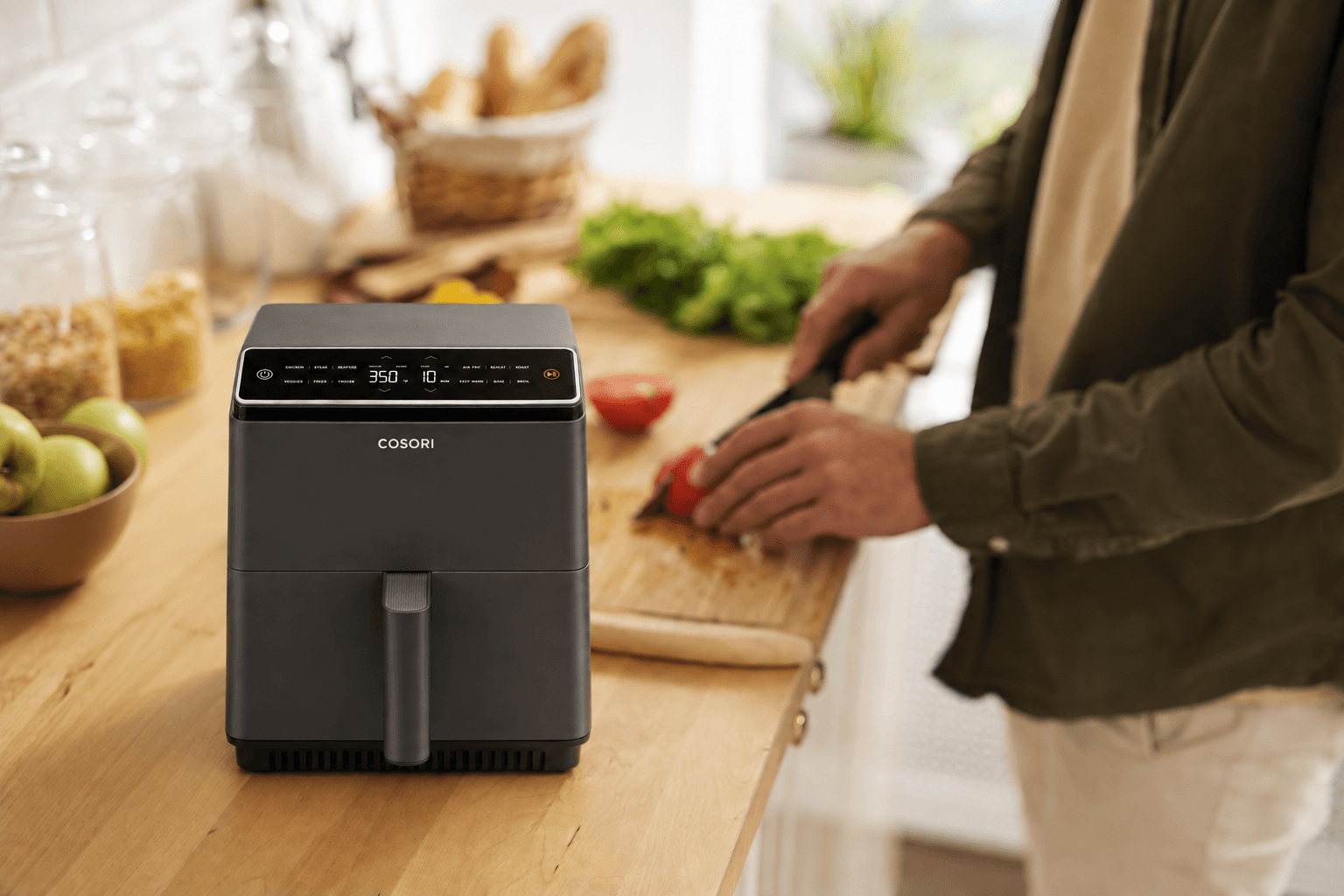
An air fryer can fit on a countertop and still be a poor fit for the place where it will actually run. The product dimensions describe the cabinet. They do not describe the open space needed around an air inlet, the path of a hot exhaust stream, the reach required to remove a basket, or the clearance between that exhaust and a wall cabinet.
Manufacturers already acknowledge this difference in their instructions. A Philips Airfryer manual specifies at least 10 cm of free space at the back, on both sides and above the appliance. COSORI's Dual Blaze page specifies 5 inches, or 13 cm, behind and above its model. A Ninja Foodi XL Pro Air Oven guide calls for at least 1 inch above and on all sides for air circulation. These are model-specific instructions, not interchangeable category rules.
For a product team, that makes countertop clearance part of the operating envelope. It should be defined while the airflow system and housing are being developed, verified in a realistic kitchen boundary, and communicated before a retailer reduces the product to width, depth and height.
The same countertop label hides different installation envelopes
“Countertop air fryer” covers drawer machines, stacked or side-by-side dual-zone models, oven-style products and pressure-cooker lids with an air-frying function. Their exterior shapes may be similar enough to compete for the same shelf, but their air paths can be different.
The Philips manual warns that hot steam is released through air outlets and requires clearance at the back, sides and top. COSORI's published clearance for two drawer-style products—the Dual Blaze and Pro LE—focuses on the space behind and above. The Ninja air-oven instruction distributes a smaller minimum around the oven. Instant Pot's FAQ gives another architecture-specific example: when using its air-fryer lid, it instructs users to leave at least 5 inches around it and not to block the vents on either the base or the lid.
The published numbers cannot establish which architecture manages heat better. They do establish that the usable footprint is not the carton footprint. A 300 mm-deep product with a 130 mm rear-clearance instruction can require more working depth than a larger-looking model whose verified boundary is different. If a product team compares only nameplate dimensions, it can optimize the wrong envelope.
| Architecture | Boundary that needs definition | Product-development question |
|---|---|---|
| Drawer air fryer | Rear and upper exhaust space, side or lower intake path, basket pull-out zone | Does the working envelope still fit a typical counter below wall cabinets? |
| Dual-zone air fryer | Exhaust behavior with one zone and both zones operating, plus full drawer travel | Does the most demanding two-zone condition change the required clearance? |
| Air-fryer oven | Top, rear and side surface proximity, door swing and tray-removal space | Can the oven run at its longest high-temperature mode inside the claimed envelope? |
| Air-fryer lid system | Vents on both lid and base, lifting and hot-lid placement area | Has the complete host-and-lid configuration been validated without obstructing either component? |
This is why a single “leave space around the appliance” sentence is weak product definition. It does not tell engineering which boundary was tested, packaging how much usable counter depth to communicate, or a buyer whether the product works under a standard wall cabinet.
Exhaust direction matters more than the external width
Clearance exists because the appliance exchanges air and rejects heat into its surroundings. The relevant geometry is therefore the relationship between the inlet, exhaust, housing surfaces and nearby boundaries—not just the maximum width of the shell.
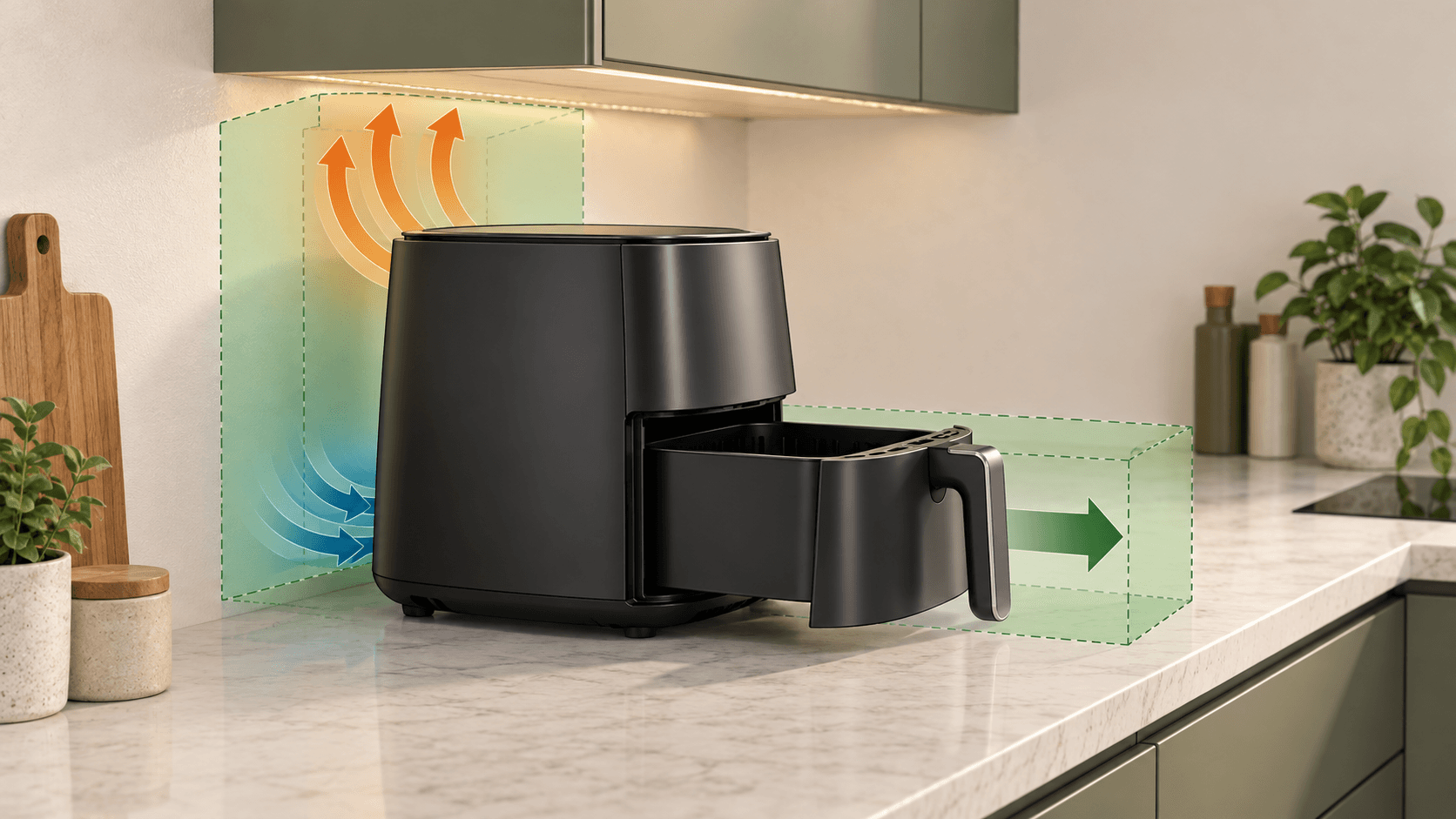
A rear outlet aimed toward a backsplash creates a different local condition from an outlet that directs flow upward or spreads it across several openings. A top intake placed under a low cabinet can face a different obstruction from a lower or side intake. Steam and aerosol released from food can also reach the nearby surface even when the appliance body itself does not touch it.
Community reports help identify where instructions are colliding with real kitchens. In one air-fryer positioning discussion, users describe pulling appliances forward during use and observing warmth or discoloration under cabinets. In another discussion about a tight cabinet opening, participants focus on a top intake and rear-upward exhaust being enclosed. These self-selected accounts do not prove a failure rate, an unsafe temperature or the cause of any damage. They do show that the location and direction of airflow are questions customers notice after purchase.
A useful specification should therefore include an airflow map. Identify every inlet and outlet, the discharge direction, and which openings must remain unobstructed in each operating configuration. Add the required open volume to the dimensional drawing. A retailer should be able to show both storage dimensions and operating dimensions without inventing either one.
A cabinet is part of the test condition
An unrestricted laboratory bench is necessary for repeatability, but it is not the only condition the product will encounter. Wall cabinets, backsplashes and adjacent appliances form boundaries that can redirect exhaust and retain heat. The validation fixture should represent those boundaries without pretending to represent every kitchen.
Start with the minimum clearances the product team intends to claim. Build a repeatable three-sided fixture using defined, instrumented surfaces rather than an arbitrary office cabinet. Run the highest relevant thermal load and the longest supported duty cycle, including preheat and consecutive batches if those uses are allowed. For a dual-zone model, include the combination that produces the highest sustained load; a one-zone run cannot automatically represent both zones operating.
Measure more than the air temperature at one convenient point. Record accessible housing temperatures, air temperature at defined locations near the exhaust, temperature rise at each boundary surface, inlet-air condition and any thermal-protection events. Observe condensation, deposits and local material changes after repeated cycles. The acceptance criteria should come from the intended materials, safety evaluation, reliability plan and user instructions—not from whether a prototype survived once.
The test also needs a performance check. If restricted placement raises inlet-air temperature or changes the available flow path, cooking consistency or component life may be affected before an obvious external failure appears. Compare the claimed minimum-clearance condition with the open-bench baseline using the same load, program, ambient condition and measurement method. A clearance claim is stronger when it protects both safe operation and the performance the product promises.
Clearance belongs in the product brief, not only the manual
When clearance is decided late, it becomes a documentation problem: engineering supplies a conservative sentence, legal reviews it, and the product page continues to advertise only compact dimensions. The customer discovers the larger operating envelope after opening the box.
The better sequence begins in the product brief. Define the target kitchen boundary, available working depth, likely cabinet height and the intended outlet direction. Treat exhaust placement as a packaging and usability decision alongside capacity. A product that must be pulled forward for every cycle may still be valid, but that behavior should be intentional and visible before purchase.
The sourcing specification should require suppliers to provide:
- a drawing that distinguishes storage dimensions, basket or door travel and operating clearances;
- inlet and exhaust locations with flow direction;
- the tested thermal load, duration, ambient condition and boundary fixture;
- temperatures and protection behavior at the claimed minimum clearance;
- results for all high-load configurations, including simultaneous zones where applicable;
- instructions and retail copy that use the same approved clearance.
That last item matters because inconsistent numbers create their own product risk. If a manual says 13 cm, a marketplace diagram implies flush-to-wall use, and customer support recommends something else, there is no single approved operating envelope. The product team should control the clearance value like any other verified specification.
Compact design should be judged by working footprint
The strongest compactness claim is not the smallest plastic housing. It is the smallest verified working envelope that still preserves unobstructed airflow, acceptable boundary temperatures, repeatable cooking performance and practical access to the basket or door.
That reframes several design choices. Redirecting an exhaust may create more value than removing a few millimeters from the side wall. A rear handle or cord exit can prevent the outlet from being pushed too close to a backsplash. Clear markings can make the operating position obvious. In some architectures, a larger chassis with a better-managed exhaust path may occupy less usable kitchen space than a smaller chassis with a large uncommunicated clearance.
Air fryer clearance is therefore not merely a warning to add after engineering is complete. It is the external boundary of the thermal and airflow system. Define it, validate it with realistic constraints, and publish it wherever product dimensions appear. That gives brands a compactness claim based on how the appliance is actually used, not how neatly it fits in a box.
Sources

Allen
Product Development & R&D, EVO
Focused on air fryer product development, engineering evaluation, OEM/ODM, sourcing and market analysis.
Related Insights
Air Fryer Airflow Development: Let the Full Load Set the Brief
A full basket can expose a weak design without identifying its cause. Learn how EVO's joint fan, air-path and structural review turns that result into better prototype comparisons and sourcing decisions.
Read ArticleShould Optional Air Fryer Features Be Quoted Separately?
Yes. Ask suppliers to price the base model and each option separately, including tooling, testing and packaging where relevant.
Read ArticleWhat Should I Confirm Before Approving an Air Fryer Sample?
Check the sample revision, accessories, controls and agreed test results against the RFQ, and record any approved deviations.
Read ArticleHave a question about this topic?
Ask EVO about the product technology, development considerations or sourcing implications discussed in this article.