
The Air Fryer Cleaning Problem Is Above the Basket
Dishwasher-safe baskets answer only part of the cleaning question. Product teams also need to specify access to fixed heater-side surfaces and test what their cleaning claims actually cover.

An air fryer basket may be dishwasher safe while the surface that collects cooking residue above it remains fixed inside an electrical appliance. The difference is already visible in manufacturers' care instructions. Philips describes dishwasher cleaning for removable pans and baskets, then gives separate steps for reaching the interior and heating element. An Instant air fryer oven manual likewise treats dishwasher-safe trays and the fixed cooking chamber separately, instructing users to inspect the heating coil and walls for oil spatter and debris.
Those instructions do not prove that every air fryer develops the same residue or is equally hard to clean. They expose a specification boundary: removable-part cleanability and fixed-system cleanability are different product properties. A brand that tests only whether a basket survives dishwashing has not yet tested whether the user can see, reach and clean the surfaces that remain in the machine.
Follow the residue after the basket comes out
The upper area combines a heater, guard, fan-side structures and nearby seams in a space constrained by heat and electrical safety. The exact geometry varies by model. Once the removable parts are out, the development question becomes concrete: which fixed surfaces are exposed to food splatter or grease-laden air, and can the customer clean them using only the method the manual permits?
Philips' published method calls for unplugging and cooling the appliance, removing the pan and basket, protecting the exterior while turning the unit upside down, and using a soft sponge or suitable brush around the heating element. That is more involved than putting a basket in a dishwasher. A flexible brush may reach behind the element on the models covered by its guidance. The instruction itself is evidence of an access task; it does not quantify how frequently a particular household needs to perform it.
The care instructions identify a task for design and user testing, but they do not isolate one fan path, food type or guard as the cause of residue. Residue formation, visibility and removal are three different outcomes. A team can measure each without claiming a universal mechanism.
Architecture changes the cleaning task
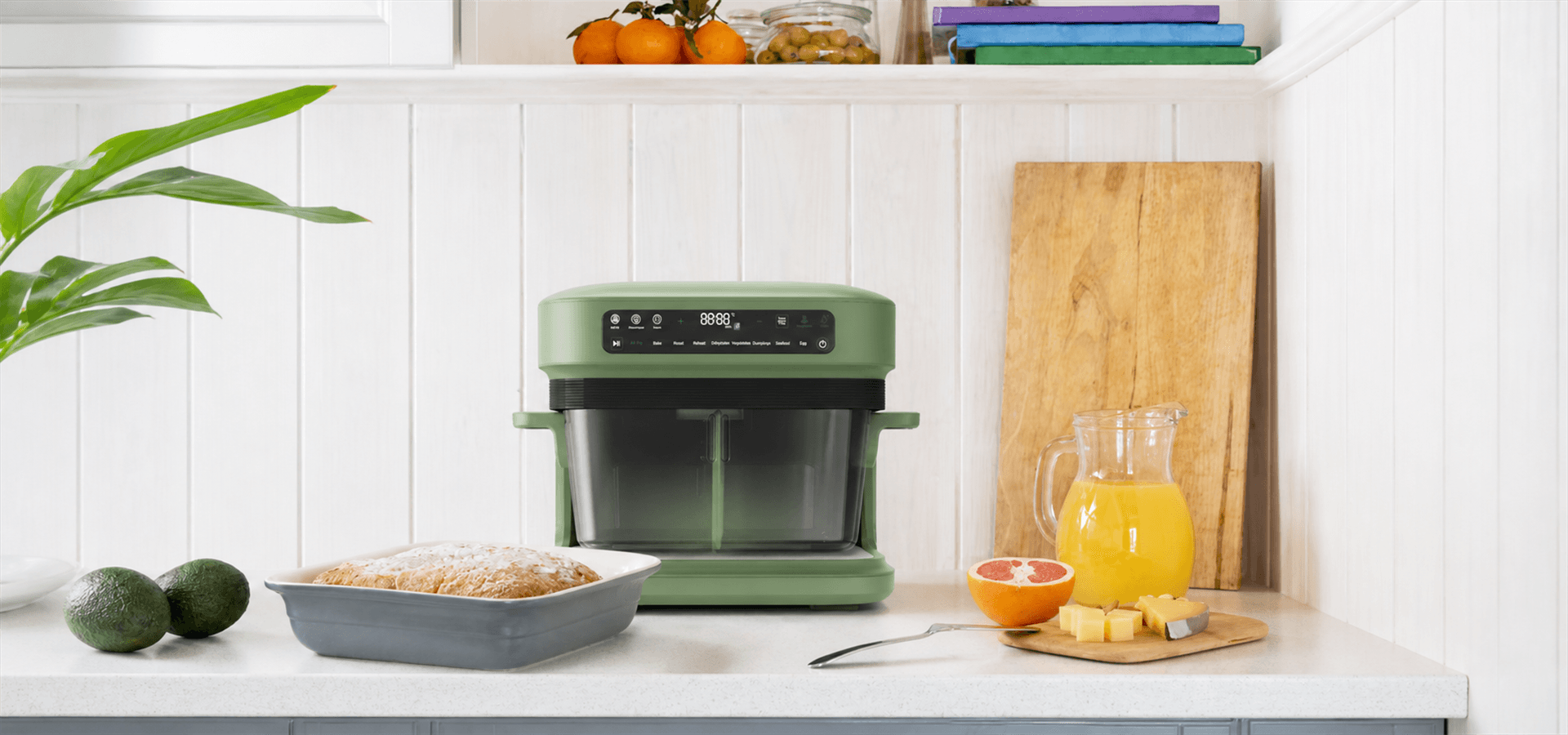
A drawer-style unit usually exposes fixed upper surfaces through the drawer opening. An oven-style unit may offer a wider front opening yet still have racks, walls and a heating coil to maintain. In a glass-vessel design, a washable vessel does not mean the powered head or pod can be immersed. Steam-assisted cleaning introduces another distinction: the cycle may loosen residue while the user still needs to wipe a specified area.
Philips' guidance for selected NA55x models makes that last boundary explicit. It describes a steam-clean cycle for the large pan and instructs the user to wipe dissolved grease around the heater afterward. This is useful product-line evidence of a defined maintenance sequence, not proof that every steam-assisted air fryer cleans its upper cavity completely or that every product has the same grease path.
The category therefore needs component-scoped claims. “Dishwasher-safe basket,” “easy-clean cavity” and “self-cleaning appliance” promise different things. They should never share one unqualified validation result.
Specify the task before specifying the claim
The first design review should map exposed fixed surfaces after representative cooking cycles. Photographs and residue maps can identify where soil appears. A separate access study should ask users to find those areas, reach them with the permitted tools and complete the manual's steps without contacting a heater, sensor, coating or seal in an unintended way. Finally, a repeat-clean study should look at the residue remaining after realistic cleaning delays and at any change to surface condition over time.
A useful supplier brief would state the model and load conditions, the surfaces included in the claim, the allowed cleaning tools, the amount and location of acceptable residual soil, and the number of use-and-clean cycles. Published care instructions do not provide a universal pass threshold. If a steam or high-temperature program is part of the proposition, test the full sequence, including any required wiping, rather than judging the program in isolation.
This approach also tests the manual. A cleaning method that is physically possible for an engineer holding a disassembled sample may still be impractical for an owner working through a drawer opening. The instruction, access geometry and claim must be validated together.
Basket dishwasher compatibility remains valuable. It is simply a narrower answer than whole-product maintainability. Product teams that define the fixed cleaning zone early can make better decisions about guard geometry, tool clearance and service instructions before the upper assembly is locked in tooling. They can also make a cleaning claim that names the surface and the method it actually covers.
Sources
- Philips, How to clean my Philips Airfryer — removable-part versus fixed-interior cleaning; model-scoped NA55x steam-clean instructions.
- Instant Brands, Air Fryer Oven User Manual — oven-style cavity maintenance context.

Allen
Product Development & R&D, EVO
Focused on air fryer product development, engineering evaluation, OEM/ODM, sourcing and market analysis.
Related Insights
Air Fryer Airflow Development: Let the Full Load Set the Brief
A full basket can expose a weak design without identifying its cause. Learn how EVO's joint fan, air-path and structural review turns that result into better prototype comparisons and sourcing decisions.
Read ArticleShould Optional Air Fryer Features Be Quoted Separately?
Yes. Ask suppliers to price the base model and each option separately, including tooling, testing and packaging where relevant.
Read ArticleWhat Should I Confirm Before Approving an Air Fryer Sample?
Check the sample revision, accessories, controls and agreed test results against the RFQ, and record any approved deviations.
Read ArticleHave a question about this topic?
Ask EVO about the product technology, development considerations or sourcing implications discussed in this article.