
What Does an Air Fryer Viewing Window Actually Let Users Decide?
A viewing window can reveal surface changes, but it cannot verify hidden food or safe internal temperature. Here is how product teams should specify and validate the decision it supports.

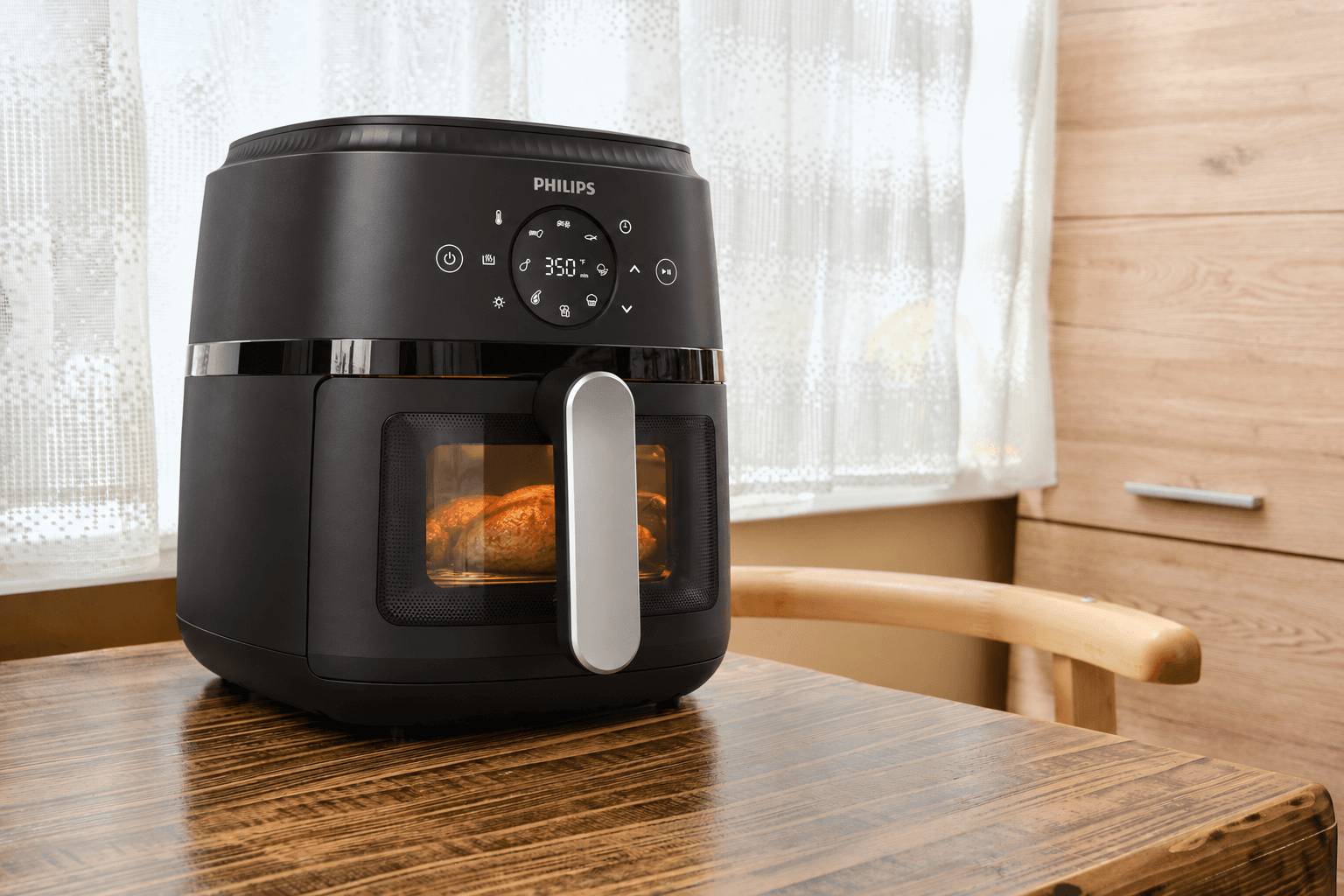
An air-fryer window seems to answer a simple question: can I see the food without pulling out the basket? That is how Instant Pot describes the ClearCook window, and COSORI makes a similar promise for its dual-basket model. The harder product-development question is what the user can *decide* from that view. A window can reveal a surface change; it cannot, by itself, establish what is happening underneath the food or at its center.
For a brand specifying a windowed air fryer, this distinction changes the brief. “Add a viewing window” names a component. “Let a user notice surface browning early enough to adjust a short cooking cycle, without opening the basket” names a task that can be tested. The latter also forces the team to ask whether the window remains useful once the basket is loaded and the appliance has been cooked in repeatedly.
Three different decisions often get called “checking the food”
The first is an observation decision: is the visible surface browning, melting, rising or approaching an unwanted state? A window and light can help with this if the food is in the sightline. Philips markets the NA231/00 cooking window around watching the food as it cooks. That is a manufacturer description of its feature, not evidence that every load is visible or that visual inspection improves cooking outcomes.
The second is an intervention decision: should the user shake, turn, separate or remove food? A view of the upper layer may show browning, but it may not reveal the underside or pieces hidden below. COSORI's product page describes both viewing windows and a shake reminder. Those are different interactions; the presence of one does not establish that the other is unnecessary. A useful specification therefore identifies the foods and loading patterns for which the window should change an action, rather than assuming a transparent panel eliminates basket handling.
The third is a verification decision: is meat or poultry safely cooked inside? A window cannot measure internal temperature. USDA FSIS warns that color is not a reliable indicator of food safety and advises using a food thermometer to check safe minimum internal temperature. Product copy that implies a visible surface proves safe doneness would cross an evidence boundary. The window can support monitoring; it does not become a food thermometer.
The view must survive a real cooking cycle
An empty, spotless basket photographed from straight ahead is a poor test of whether the window does its job. The relevant view is through a normally loaded basket, from where a person naturally stands, at the moment they need to decide whether to intervene. Food height, a crisper plate, basket depth, the light position and reflections can all change what is visible. These are design variables to test, not asserted flaws in the Philips, Instant Pot or COSORI products cited here.
The window also creates a maintenance question. In a recent owner discussion, some contributors describe useful checks for foods such as cheese or toast; others say they still pull out the basket or find that residue obscures the view. These individual accounts cannot establish how often any model performs well or poorly. They do, however, give a product team specific conditions to examine: a quick-changing food, an ordinary mixed load, and the same window after repeated cooking and cleaning.
The meaningful criterion is not optical perfection at the factory. It is whether the user can recognize the intended visual cue at the decision point over the maintenance interval the brand promises. If the feature requires cleaning, the access method and approved cleaning instructions belong in the usability review. If the light is user-controlled or timed, its behavior belongs in the same test. A dark or difficult-to-maintain view can make a nominal window functionally irrelevant, but that conclusion must come from the actual design and test, not from the category label.
Specify the decision before choosing the window geometry
A supplier brief can make the feature testable without inventing a universal window size. First, name the target observation: for example, visible top-surface browning on a shallow, single-layer load near the end of a short cycle. Then set the representative food, load mass and distribution, basket configuration, program, viewing position, lighting condition and timing. Record whether users can identify the cue and what action they take. Repeat with a higher or more crowded load to expose the feature's limits rather than hiding them.
| User question | What a window might show | What still needs another check | Proposed validation |
|---|---|---|---|
| Is a visible surface browning too far? | The exposed upper surface, if it is within the sightline | Concealed pieces and underside browning | Compare users' decisions with and without the window at the same late-cycle point |
| Should I shake or turn the food? | Surface color and some movement | Whether food underneath is sticking or cooking evenly | Test a defined load, then inspect the full basket after the decision |
| Is a meat or poultry item safe to serve? | Exterior appearance only | Internal temperature at an appropriate location | Use a food thermometer under applicable food-safety guidance |
| Is the feature still useful after repeated use? | Clarity through the maintained window | Long-term visibility and cleaning effort | Recheck the same viewing task after a documented use-and-cleaning sequence |
This is a proposed validation matrix, not reported EVO test data. A product team can choose different foods and acceptance thresholds for its target market. What should remain constant is the relationship between the claim, the user decision and the test. Counting basket openings alone would miss cases where the user looks through the window but still has to pull the basket out to know what to do.
The product decision is an observability contract
Windowed air fryers are not all making the same promise. Philips emphasizes watching the food, Instant Pot emphasizes checking without opening, and COSORI includes a window alongside a separate shake reminder. These pages establish what the manufacturers say their features are for; they do not provide a head-to-head measure of visibility or cooking performance.
For a brand or sourcing team, the practical approval rule is to ask for a demonstrable observation → action → verification chain. The design should show the intended cue under a specified load; the user should be able to act on that cue; and any claim about the outcome should be checked by an appropriate method. If the task is surface browning, a repeatable visual-use test may be relevant. If the task is food safety, the verification cannot stop at the window. That boundary makes a viewing window a defensible interface feature rather than a decorative answer to a question it cannot actually resolve.
Sources
- Philips 2000 Series Airfryer NA231/00 — manufacturer's cooking-window description.
- Instant Pot Vortex Plus 6QT ClearCook — manufacturer's basket-checking description.
- COSORI 9.0-Quart Dual Basket Air Fryer — manufacturer's window and shake-reminder descriptions.
- USDA FSIS, Food Thermometers — limits of visual color as a food-safety indicator.
- AirFryTalk owner discussion — anecdotal, conflicting owner experiences; not prevalence or performance evidence.

Allen
Product Development & R&D, EVO
Focused on air fryer product development, engineering evaluation, OEM/ODM, sourcing and market analysis.
Related Insights
Air Fryer Airflow Development: Let the Full Load Set the Brief
A full basket can expose a weak design without identifying its cause. Learn how EVO's joint fan, air-path and structural review turns that result into better prototype comparisons and sourcing decisions.
Read ArticleShould Optional Air Fryer Features Be Quoted Separately?
Yes. Ask suppliers to price the base model and each option separately, including tooling, testing and packaging where relevant.
Read ArticleWhat Should I Confirm Before Approving an Air Fryer Sample?
Check the sample revision, accessories, controls and agreed test results against the RFQ, and record any approved deviations.
Read ArticleHave a question about this topic?
Ask EVO about the product technology, development considerations or sourcing implications discussed in this article.