
Why Can a Stacked Air Fryer Cook Unevenly? The Ninja DoubleStack Design Question
Ninja's DoubleStack puts two cooking zones in a narrow footprint. Its design shows why basket position, rack loading and airflow must be tested together before a brand promises even cooking.

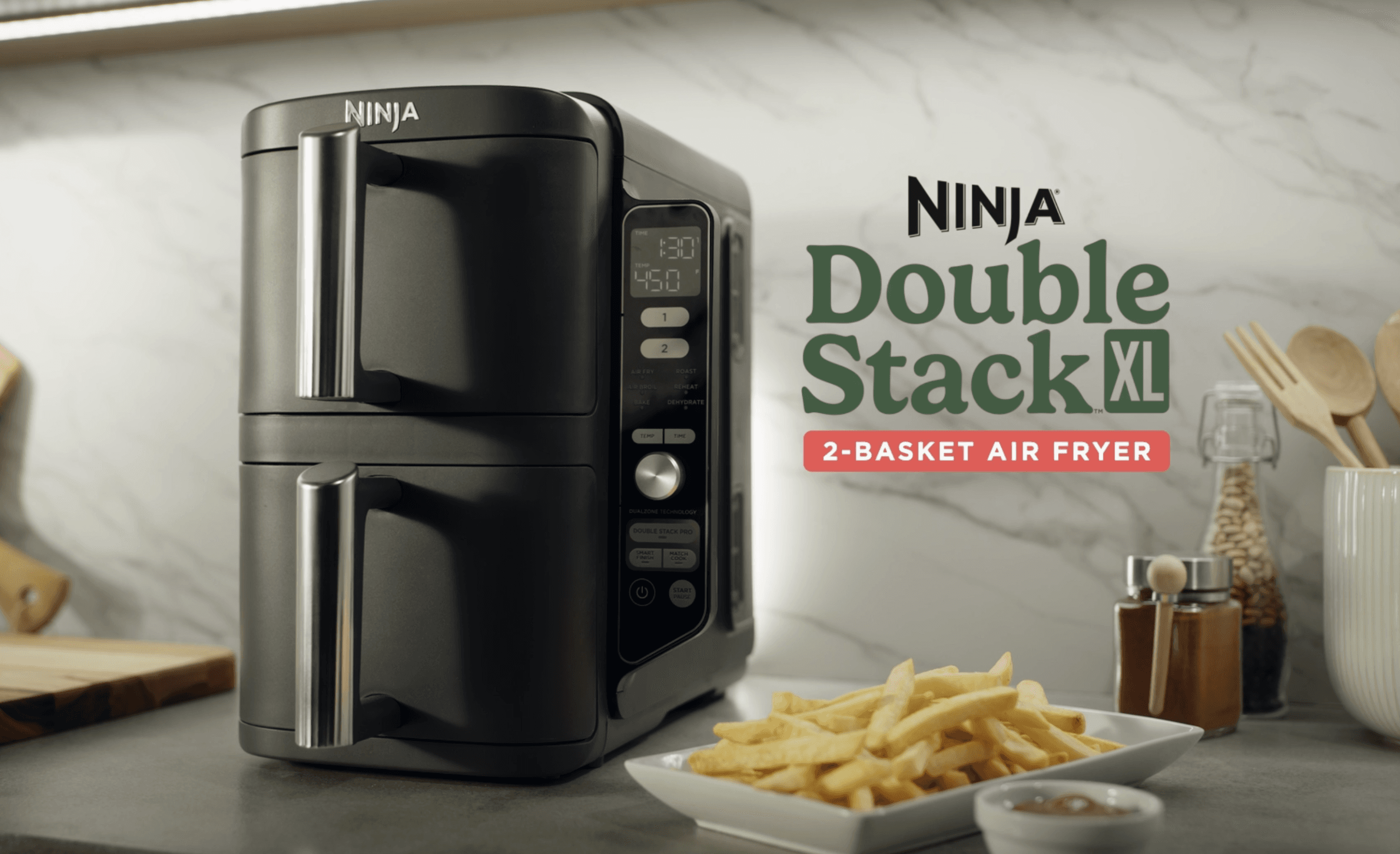
Two baskets stacked vertically can free counter space without giving up separate cooking zones. Ninja's DoubleStack range adds a second kind of stacking: a removable rack can split each basket into two food levels. That creates an attractive four-level meal proposition. It also changes the question a product team must answer. A cooking result measured in an empty drawer, or with one thin layer of food, does not establish what happens at the front and rear of a loaded basket or above and below a rack.
The distinction matters because “Ninja DoubleStack” covers different models. Ninja describes the US SL401 as two 5-quart baskets with stacked meal racks and programs for coordinating the zones. In a separate, model-specific test, RTINGS reported uneven browning from the smaller SL201 and observed that food toward the basket front cooked less than food nearer the rear heating system. That result is a reason to investigate this architecture. It is not a measured performance result for every DoubleStack variant, food or loading pattern.
The footprint gain changes the heat path
A side-by-side dual-basket appliance uses horizontal counter space. Stacking the baskets narrows the appliance, while the UK SL400UK product page still describes two independently controlled drawers. RTINGS' tested SL201 places its heating elements and fans at the rear of the baskets. That model-specific arrangement is a real design choice, not evidence that the two drawers share one undifferentiated airflow stream.
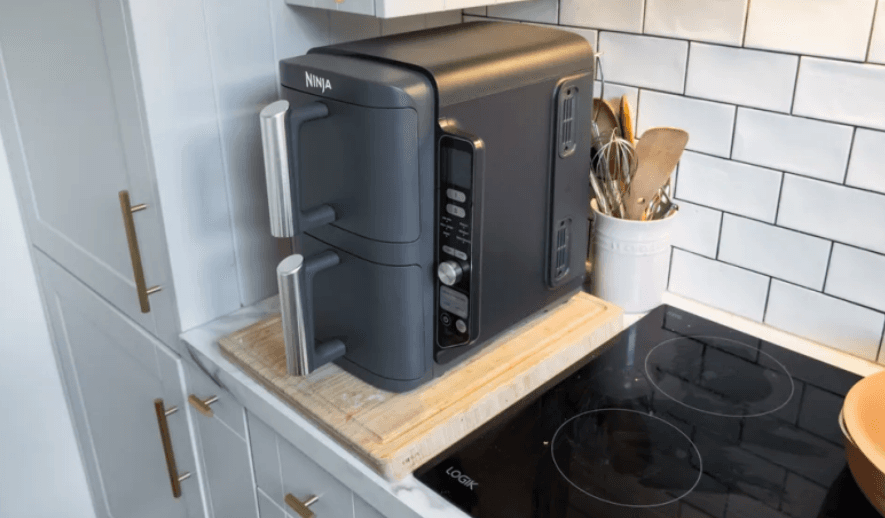
Moving the heat source and fan behind a basket changes the distance and route by which hot air reaches food. Basket depth, crisper-plate openings, load height and the obstruction created by a meal rack may all affect the local result. The direction and size of any effect must be measured for a specific model. The layout alone cannot establish that heat accumulates at the basket front or that moisture transfers between the two drawers.
RTINGS' SL201 test provides a useful contrast. It reported relatively stable temperature during cooking but much weaker frying uniformity. A stable chamber temperature therefore does not, by itself, prove that every food position receives comparable convective heat and browning. The site's result is tied to its particular unit and test food; it should be treated as a measured warning about what a temperature-only specification can miss, rather than as a verdict on the whole range.
Four food positions are four validation conditions
The rack is the most consequential addition to the standard two-zone story. It can increase usable cooking surface, yet food on the rack may shield food below it, and the lower layer may alter the path available to air. Ninja's SL400UK product description explicitly presents cooking four foods on four levels as an intended use. The claim defines a condition a product team should test; it does not establish that every food combination produces identical browning without intervention.
For a brand comparing stacked and side-by-side designs, the honest unit of evaluation is a *meal configuration*, not the printed total capacity. A sensible test includes at least one single-layer load, a full two-level load in one drawer, and simultaneous two-drawer operation. Within each condition, record food positions at the front and rear and above and below the rack. Hold food mass, cut size, initial temperature, oil application, program, set temperature and intervention schedule constant. Record both the cooking endpoint and the spread across positions. Repeating the same run after swapping drawer positions can help distinguish a consistent location effect from a one-off load difference.
The acceptance criteria must fit the product promise: uniform browning, finished food temperature, moisture loss or another declared outcome may each require a different measurement. A product that performs well with two foods should not automatically be marketed as equivalent with four.
The claim should match the tested load
Ninja's product page presents the DoubleStack as a way to cook several foods in less counter space. That is a footprint and configuration proposition. If a competing brand wants to add an “even cooking on four levels” claim, it needs evidence from the four-level configuration, including the foods, load, settings and user actions needed to obtain the result. Comparing only the programmed temperature of two zones would miss the front-to-rear and rack-to-plate questions.
The same discipline applies to usability. Shaking a shallow basket of fries is different from interrupting a four-level meal, removing a hot rack and repositioning several foods. Product teams should evaluate that task with the actual rack, handle clearance and instructions. A smaller footprint is valuable only if the resulting cooking and handling trade-offs fit the intended customer and use case.
The DoubleStack illustrates a wider product-development lesson: capacity, zone independence and cooking uniformity are separate specifications. The strongest sourcing brief states which meal configurations must work, how evenness will be measured at each food position, and which interventions the user is expected to perform. That lets a manufacturer defend a compact layout with evidence instead of assuming that two identical basket volumes will produce identical meals.
Sources
- Ninja, DoubleStack XL SL401 product page — US model configuration and manufacturer claims.
- Ninja UK, Double Stack XL SL400UK product page — four-level cooking proposition and UK model details.
- RTINGS, Ninja DoubleStack SL201 review — independent results for the SL201 only.

Allen
Product Development & R&D, EVO
Focused on air fryer product development, engineering evaluation, OEM/ODM, sourcing and market analysis.
Related Insights
Air Fryer Airflow Development: Let the Full Load Set the Brief
A full basket can expose a weak design without identifying its cause. Learn how EVO's joint fan, air-path and structural review turns that result into better prototype comparisons and sourcing decisions.
Read ArticleShould Optional Air Fryer Features Be Quoted Separately?
Yes. Ask suppliers to price the base model and each option separately, including tooling, testing and packaging where relevant.
Read ArticleWhat Should I Confirm Before Approving an Air Fryer Sample?
Check the sample revision, accessories, controls and agreed test results against the RFQ, and record any approved deviations.
Read ArticleHave a question about this topic?
Ask EVO about the product technology, development considerations or sourcing implications discussed in this article.