
How to Freeze an Air Fryer Golden Sample Before Mass Production
A signed air fryer sample is not a complete production baseline. Buyers need configuration identity, evidence mapping, packaging control and change approval around it.

A golden sample is often treated as the moment an air fryer project becomes stable. The buyer signs a label, the supplier stores a unit, and both sides move toward mass production. Yet a physical sample can preserve only what can be seen and measured on that particular unit. It does not automatically identify the firmware, critical components, food-contact material formulation, packaging version or test evidence that made the sample acceptable.
The sourcing task is therefore not simply to sign a good appliance. It is to freeze a reproducible product definition around it. A useful golden-sample package connects the approved unit to controlled records, defines which changes require review and gives production inspection a baseline it can actually verify.
Approval begins with one exact configuration
Before signature, record the complete identity of the unit being approved: model and internal project number, destination market, voltage and frequency, rated power, plug and cord, colour, control-panel language, firmware or program version, vessel and accessory set, label revision and packaging version.
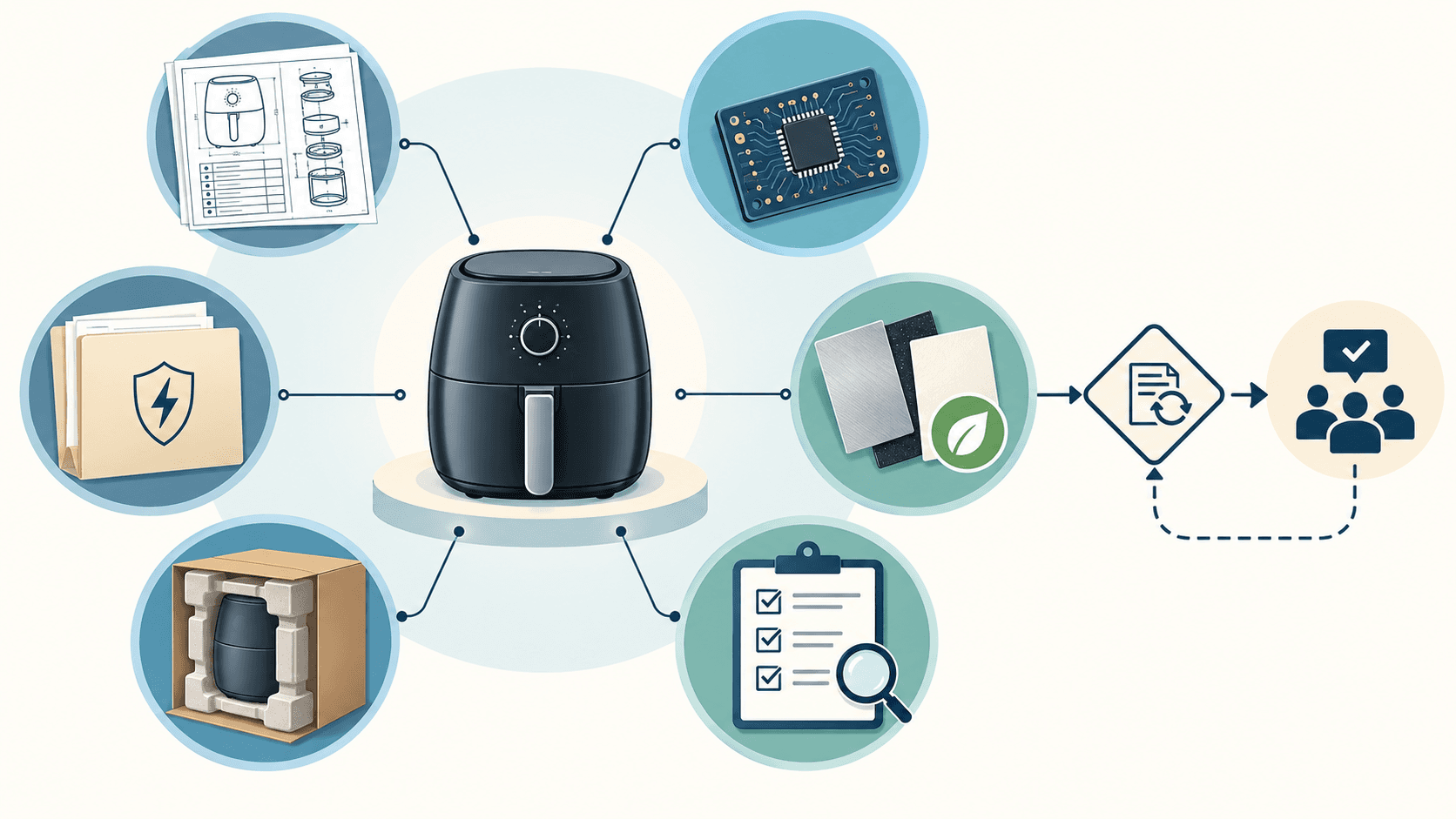
Photographs help, but they cannot replace identifiers. Two heaters may look identical while carrying different ratings. A control board substitution may preserve the display but alter temperature behaviour. A basket coating or glass-vessel supplier change can be invisible in a finished sample. Link the physical unit to the approved bill of materials, drawings and critical-component list.
If several regional or retail variants exist, do not use one signature as a blanket approval. Create a variant matrix showing what is shared and what differs. Each approved sample should have a bounded scope.
Give the reference unit a durable sample ID and record its approval date, condition and custodians. A sample that cannot be distinguished from later engineering units is not a reliable control object.
Freeze functions as measured behaviour
The golden sample should capture the behaviours that matter to the product promise. For an air fryer, that may include control logic, preheat behaviour, displayed versus measured temperature, recovery after food loading, fan operation, cooking uniformity, drawer or vessel detection, alarm logic and protection response.
Record the test method alongside the result. A statement such as “temperature passed” is not reproducible unless the mode, setpoint, supply voltage, load, measurement position, stabilisation period and acceptance range are known. The signed appliance is a reference unit; the method explains how future units will be compared with it.
Not every development test belongs in routine inspection. Separate qualification evidence from production controls. Qualification can establish complete-appliance performance and safety on representative units. End-of-line checks should detect relevant assembly or component drift efficiently. Final inspection can then sample visible, functional and packaging attributes without pretending to repeat the entire validation programme.
Connect safety evidence to the signed unit
IEC 60335-2-9 covers portable household cooking appliances, and the 2026 pre-release edition explicitly adds requirements for portable air fryers. Whatever certification route applies to the destination market, the evidence file must describe the construction being produced—not merely a similar platform.
Create a report-to-product map. It should connect report or declaration identifiers to the approved model, rating, enclosure, heater, motor or fan, controls, thermal protection, wiring, cord set, labels and instructions. Where a component is critical to the assessed construction, record its manufacturer, model and relevant rating in the controlled list.
The EU Blue Guide also addresses products made available after physical modifications or software updates. That does not mean every production change creates a new product, but it reinforces the need to evaluate changes rather than assuming that an old evidence file follows any revised construction.
Record the evaluation outcome even when no retest is required. The value of change control is not only the test it triggers; it is the documented reasoning that keeps a revised production unit connected to the accepted evidence boundary.
Treat food-contact parts as controlled evidence objects
The European Commission states that food-contact materials must comply with Regulation (EC) No 1935/2004 and be manufactured under the good-manufacturing-practice framework of Regulation (EC) No 2023/2006. Its guidance also emphasizes compliance documentation and traceability.
For the golden-sample package, list every intended food-contact part: basket, crisper plate, tray, rack, vessel, lid or other relevant surface. Connect each part number to material, coating or formulation identity where applicable, colour, supplier, conditions of use and supporting declaration or test evidence.
A signed surface appearance does not freeze chemistry. The change rule should therefore cover coating supplier, resin or formulation, colourant, substrate, thickness range and process changes that could affect the evidence boundary. Approved alternatives should be listed explicitly; an unlisted “equivalent material” remains a proposed change.
Packaging needs its own golden configuration
The appliance sample and its retail pack should be approved as one commercial configuration. Freeze the accessory count, protective inserts, bags, films, labels, manuals, gift box, master carton, sealing method and packing orientation. Record product, packed-unit and carton weights as well as the intended pieces per carton.
Distribution validation should use the same pack-out. If the factory improves, reduces or substitutes protective material after testing, the earlier result may no longer describe production. Glass vessels and exposed handles make this especially important because a small support or clearance change can alter how shocks travel through the pack.
Packaging artwork also controls claims and model identity. The golden package should link the approved artwork revision to the matching appliance, accessories, rating and instructions rather than treating graphics as a separate marketing file.
Build the change-control gate before production
The strongest golden sample is paired with a simple change matrix.
| Proposed change | Minimum review | Typical evidence affected | Release authority |
|---|---|---|---|
| Cosmetic colour or print | Identity and material review | Artwork, colour standard, material declaration | Buyer product and quality owners |
| Heater, fan, sensor or control-board substitution | Engineering review and focused revalidation | Performance, safety construction, critical-component list | Buyer engineering and quality owners |
| Firmware or control-logic revision | Functional risk review and regression test | Temperature behaviour, programs, alarms, protection logic | Buyer product, engineering and quality owners |
| Food-contact material or coating change | Compliance and process review | Declaration, migration evidence, traceability and cleaning claims | Buyer compliance and quality owners |
| Packaging material or arrangement change | Pack review and distribution revalidation as needed | Dimensions, weights, protection and loading | Buyer packaging and quality owners |
The matrix should state what the supplier may change without prior approval, what requires document review, and what requires a new sample or broader requalification. “Equal or better” is not a decision rule unless equivalence criteria and approving authority are defined.
Translate the baseline into production controls
A golden sample cannot inspect a factory. The control plan must translate its critical attributes into incoming checks, process controls, end-of-line tests, final inspection and traceability records.
Use sampling deliberately. ISO 28590 introduces the ISO 2859 family of attribute-sampling systems and guidance for selecting an appropriate inspection system. AQL-based final inspection can be useful for defined attributes, but it does not validate design, approve substitutions or guarantee every unit. Critical safety and configuration controls should be managed at the process and traceability level, not delegated entirely to a shipment sample.
Define defect examples against the approved baseline, but avoid relying only on visual resemblance. Include measurable limits, gauges or test methods for dimensions, assembly, control behaviour, electrical checks, temperatures, noise or airflow proxies where these are meaningful for the design.
Trace the result back to the production lot, line, test station and relevant component batches. Without that connection, a failed inspection can identify a symptom but cannot reliably contain the affected product or expose the upstream change.
Close approval with a controlled handoff
The final golden-sample file should contain the signed unit identity, configuration register, approved BOM and drawings, critical-component list, firmware reference, functional acceptance record, compliance map, food-contact evidence index, packaging specification, artwork revisions, change matrix and production control plan.
Store at least one protected reference under defined conditions and record who holds each counterpart. If ageing, handling or later investigation makes the physical unit unreliable, the controlled records should still preserve the approved definition.
Mass production is ready when the supplier can reproduce the approved configuration, the buyer can recognize unauthorized change, and both sides know what evidence must be reopened when a change is proposed. The signature on the sample marks agreement; the connected control system makes that agreement durable.
Sources
- International Electrotechnical Commission, “IEC 60335-2-9:2026 — Particular requirements for grills, toasters and similar portable cooking appliances (pre-release version)”: https://webstore.iec.ch/en/publication/116678
- European Commission, “The Blue Guide on the implementation of the product rules 2022”: https://single-market-economy.ec.europa.eu/news/blue-guide-implementation-product-rules-2022-published-2022-06-29_en
- European Commission, “Food Contact Materials”: https://food.ec.europa.eu/food-safety/chemical-safety/food-contact-materials_en
- European Commission, “Food Contact Materials Legislation”: https://food.ec.europa.eu/food-safety/chemical-safety/food-contact-materials/legislation_en
- International Organization for Standardization, “ISO 28590:2017 — Sampling procedures for inspection by attributes”: https://www.iso.org/standard/64622.html

Allen
Product Development & R&D, EVO
Focused on air fryer product development, engineering evaluation, OEM/ODM, sourcing and market analysis.
Related Insights
Air Fryer Airflow Development: Let the Full Load Set the Brief
A full basket can expose a weak design without identifying its cause. Learn how EVO's joint fan, air-path and structural review turns that result into better prototype comparisons and sourcing decisions.
Read ArticleShould Optional Air Fryer Features Be Quoted Separately?
Yes. Ask suppliers to price the base model and each option separately, including tooling, testing and packaging where relevant.
Read ArticleWhat Should I Confirm Before Approving an Air Fryer Sample?
Check the sample revision, accessories, controls and agreed test results against the RFQ, and record any approved deviations.
Read ArticleHave a question about this topic?
Ask EVO about the product technology, development considerations or sourcing implications discussed in this article.