
Ninja Crispi MW101 Turns the Cooking Vessel Into a Mode Boundary
Ninja's MW101 automates the microwave-to-air-fry handoff around a designated glass vessel. We analyze the loading, compatibility and validation trade-offs.

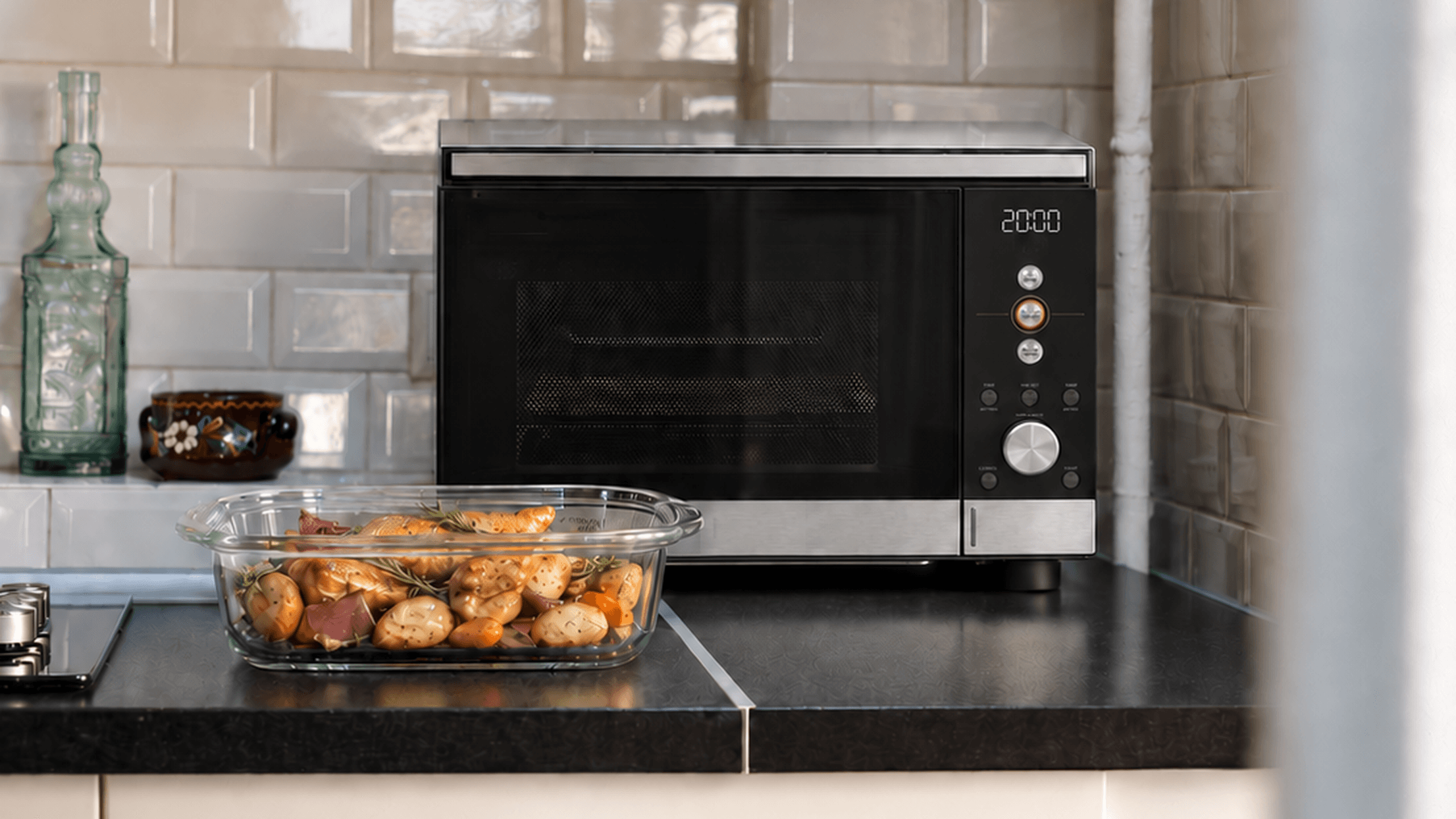
The Ninja Crispi MW101 puts a microwave and hot-air cooking in one countertop cavity. SharkNinja announced it in July 2026 for the US market. The product can start with microwave heat and finish with air frying automatically. That sequence is a more useful starting point for product teams than the number of programs on its panel: it asks whether a single container and cooking path can take food from rapid heating to a convincing surface finish without a manual transfer.
The combination is old; the interface is the question
Microwave-plus-air-fry appliances did not begin with the MW101. Panasonic introduced the HomeChef NN-CD87KS in 2020 with microwave, air-fry, convection and broil functions. It is a historical category baseline, not a matched performance rival. Ninja's differentiating proposition is more specific: a microwave-first, hot-air-finish program within a flatbed cavity, using included 5.5-quart glassware and a crisper plate.
The comparison inside Ninja's own family is just as instructive. The Crispi FN101 puts a detachable heater over smaller glass containers. MW101 places the glass vessel inside a fixed microwave and air-fry chamber. FN101 is a sibling, not a verified direct predecessor. Moving the vessel inside a dual-mode cavity changes the interfaces a design team has to control: where the container sits, which mode it supports, how the user lifts it, and what other cookware can be used.
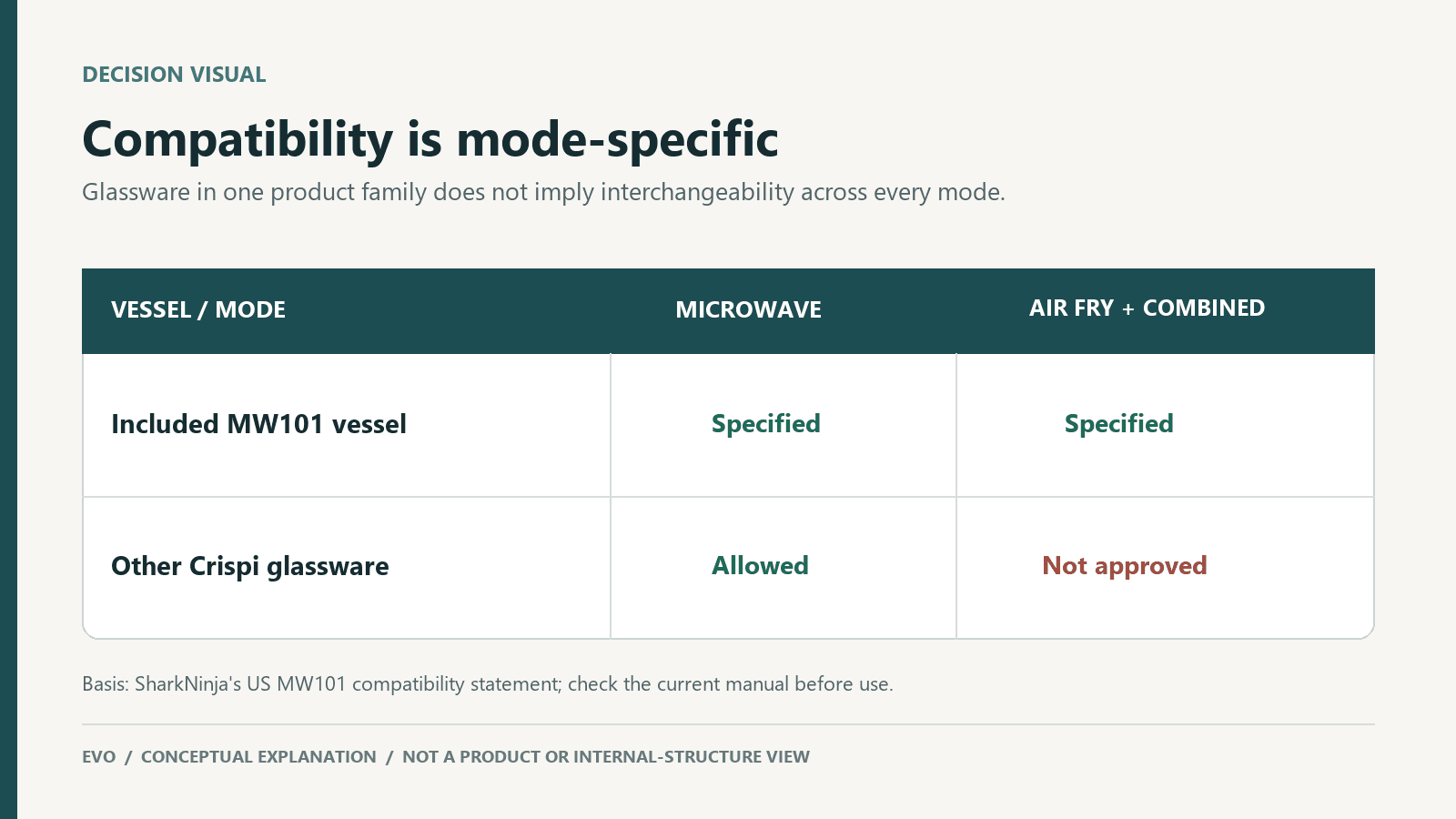
Ninja states that other Crispi glassware can be used in MW101's microwave mode only. For air frying and its combined program, the company specifies the glassware included with MW101. That restriction matters more than a broad “glass cooking” claim. The permitted vessel is part of the operating architecture, not a free-choice accessory. A product brief therefore needs a compatibility matrix by vessel and mode, backed by clear physical fit and instructions that users can follow without interpreting model-family names.
A flatbed gives loading freedom, then the glassware sets a new limit
The MW101 eliminates a rotating turntable. A stationary floor can accept a rectangular dish that would otherwise have to clear a circular path. That is a geometry benefit, especially for microwave-only use. Yet the air-fry meal uses a particular glass container and crisper plate, which define a smaller, shaped food surface inside the cavity. The advertised vessel volume, overall oven volume and area available for a single-layer air-fry load describe three different constraints.
RTINGS' test of a silver MW101 measured about 0.88 cubic feet of chamber volume and described the air-fry cooking surface as fairly compact. Those observations should not be converted into a universal food-capacity verdict; the result depends on the vessel, food and test setup. They do show why a buyer's specification should ask for usable dimensions in each mode. A large flatbed microwave space does not automatically make a large air-fry tray.
The less obvious implication is that the same flatbed can solve one loading problem while exposing another. Removing the turntable makes ordinary dish placement more flexible. Air frying then reintroduces a controlled placement requirement through the glassware and plate. A manufacturer evaluating a similar platform should measure actual single-layer food area, clearance around the vessel, and the space needed for a hand to remove a hot load. None is captured by a cubic-foot or quart figure alone.
The handoff needs a meal-level test
Ninja calls its automatic sequence FusionCrisp. The documented function is microwave heating followed by hot-air finishing. The name alone says nothing about an unusual emitter, fan, sensor or control algorithm. What can be inferred is the engineering test it creates. A mode change must reach a useful food state: a sufficiently heated center with a surface that can still dry and brown in the remaining time.
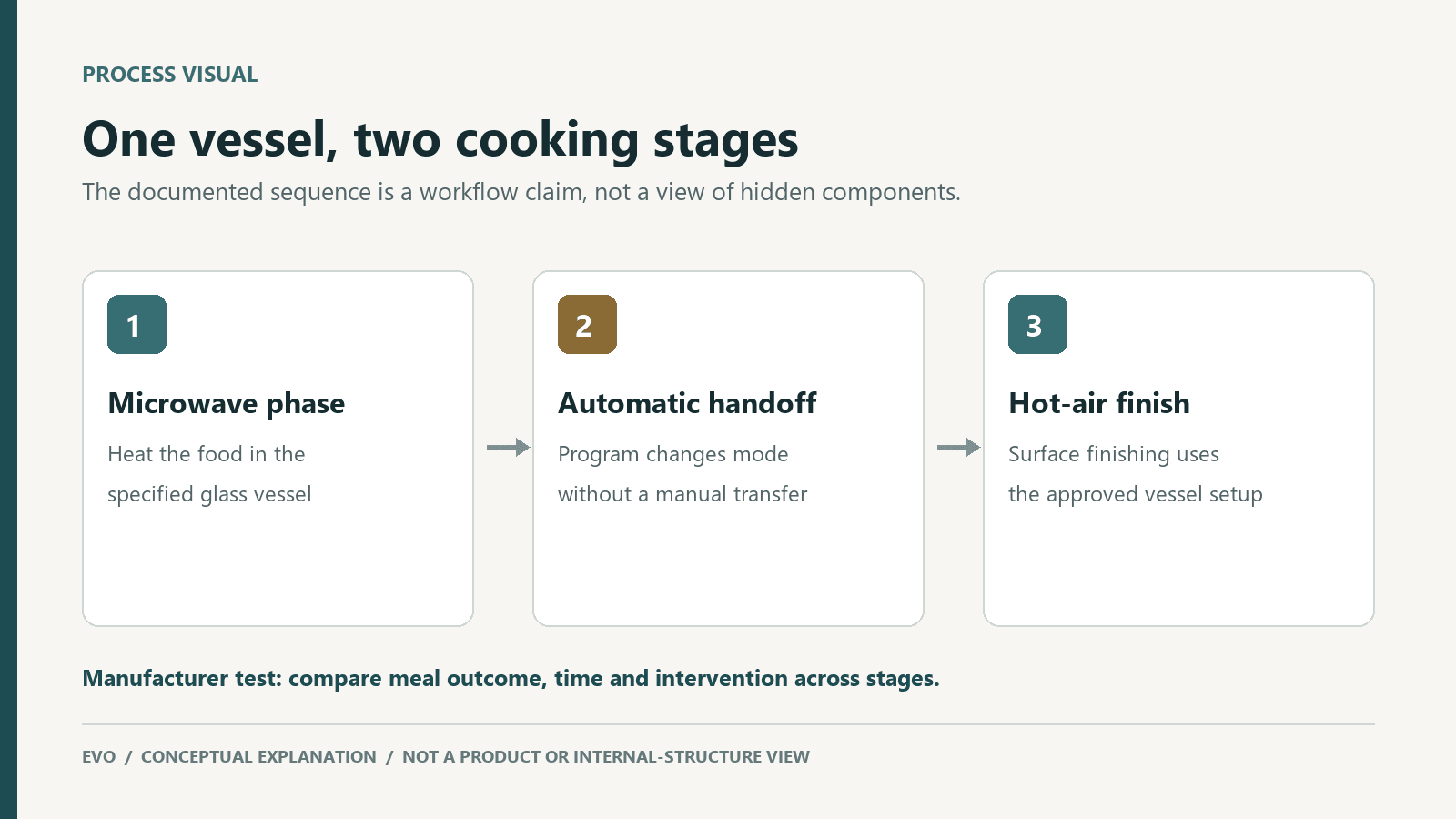
That balance depends on food geometry and moisture. A dense frozen item, a thin leftover and a high-water dish need different transitions. Starting the hot-air stage too soon could leave a cold center; starting it too late could shorten the time available for surface texture. These are possible failure modes to test, not findings about MW101. Compare the automatic sequence with microwave-only, air-fry-only and manually sequenced cooking using the same food mass, initial temperature and final food-safety endpoint. Record center temperature, surface color or texture, elapsed time, energy input and any user intervention.
Independent testing gives the thermal side a concrete prompt. RTINGS reported roughly six minutes to reach 400°F in its air-fry test and temperature swings under its method. The result is specific to its sample and setup. For a product team, it suggests measuring the short finishing stage itself rather than assuming an air-fry rating predicts meal-level performance. The key question is how much of the sequence's total time is spent heating the chamber, how much is useful finishing time, and whether food quality is repeatable across realistic loads.
One appliance removes a transfer and adds an accessory system
The combined program can spare a user from moving food between a microwave dish and a separate air fryer. That is a plausible workflow benefit, not a measured reduction in preparation time for every meal. It comes with a product-system cost: a heavier removable glass vessel, a crisper plate, hot handling, cleaning and replacement parts. The fixed cavity also has to remain usable after grease-producing hot-air cooks and ordinary microwave reheating.
The sourcing question is practical. Can the approved vessel be supplied consistently to its fit tolerance, survive repeated heating and washing, and remain available as a replacement? Does the product communicate clearly that some family glassware is microwave-only in this machine? A brand copying the visible glass aesthetic without the compatibility and aftersales plan would copy the easy part of the design and miss the risk boundary.
There is a fair counterargument to the single-vessel thesis. Many owners may use microwave and air-fry modes separately, making the automatic transition less important than convenient dual use in one footprint. A manufacturer should therefore test both use models. If independent modes supply most of the value, the combined program need not drive the entire platform specification. If meal-level sequencing is the differentiator, then its success criteria must be defined by food outcomes and intervention, not by the presence of a branded button.
What manufacturers should specify
For a comparable product, begin with three representative meals: a microwave-only reheating load, a single-layer air-fry load, and a frozen or chilled meal that genuinely benefits from both stages. Specify the vessel for each, its usable food area, the loading and removal task, and the measured cooking endpoint. Then test repeated mode transitions, cleaning and glassware replacement. That gives industrial design, thermal engineering, sourcing and aftersales teams one shared definition of “combined cooking.”
MW101 is one implementation in an established combination category. Panasonic's older product prevents a category-first story; Ninja's vessel restriction and automatic sequence make this a distinct product-development case. Whether customers prefer that case, or whether it performs better than separate appliances, remains open. The next useful evidence is a controlled meal study across the three modes and several loads, alongside a durability study of the designated vessel.

Allen
Product Development & R&D, EVO
Focused on air fryer product development, engineering evaluation, OEM/ODM, sourcing and market analysis.
Related Insights
Severin FR 2474 Moves the First Air-Fryer Decision to Food Recognition
The FR 2474 says it recognizes food before choosing cooking settings. We examine the control-workflow change and what manufacturers must validate.
Read Article
What Does an Air Fryer Viewing Window Actually Let Users Decide?
A viewing window can reveal surface changes, but it cannot verify hidden food or safe internal temperature. Here is how product teams should specify and validate the decision it supports.
Read Article
Why Can a Stacked Air Fryer Cook Unevenly? The Ninja DoubleStack Design Question
Ninja's DoubleStack puts two cooking zones in a narrow footprint. Its design shows why basket position, rack loading and airflow must be tested together before a brand promises even cooking.
Read ArticleHave a question about this topic?
Ask EVO about the product technology, development considerations or sourcing implications discussed in this article.